Greek Visions
Plato's Allegory of the Cave
Plato's Allegory of the Cave
Couldn't load pickup availability
Size Chart
Size Chart

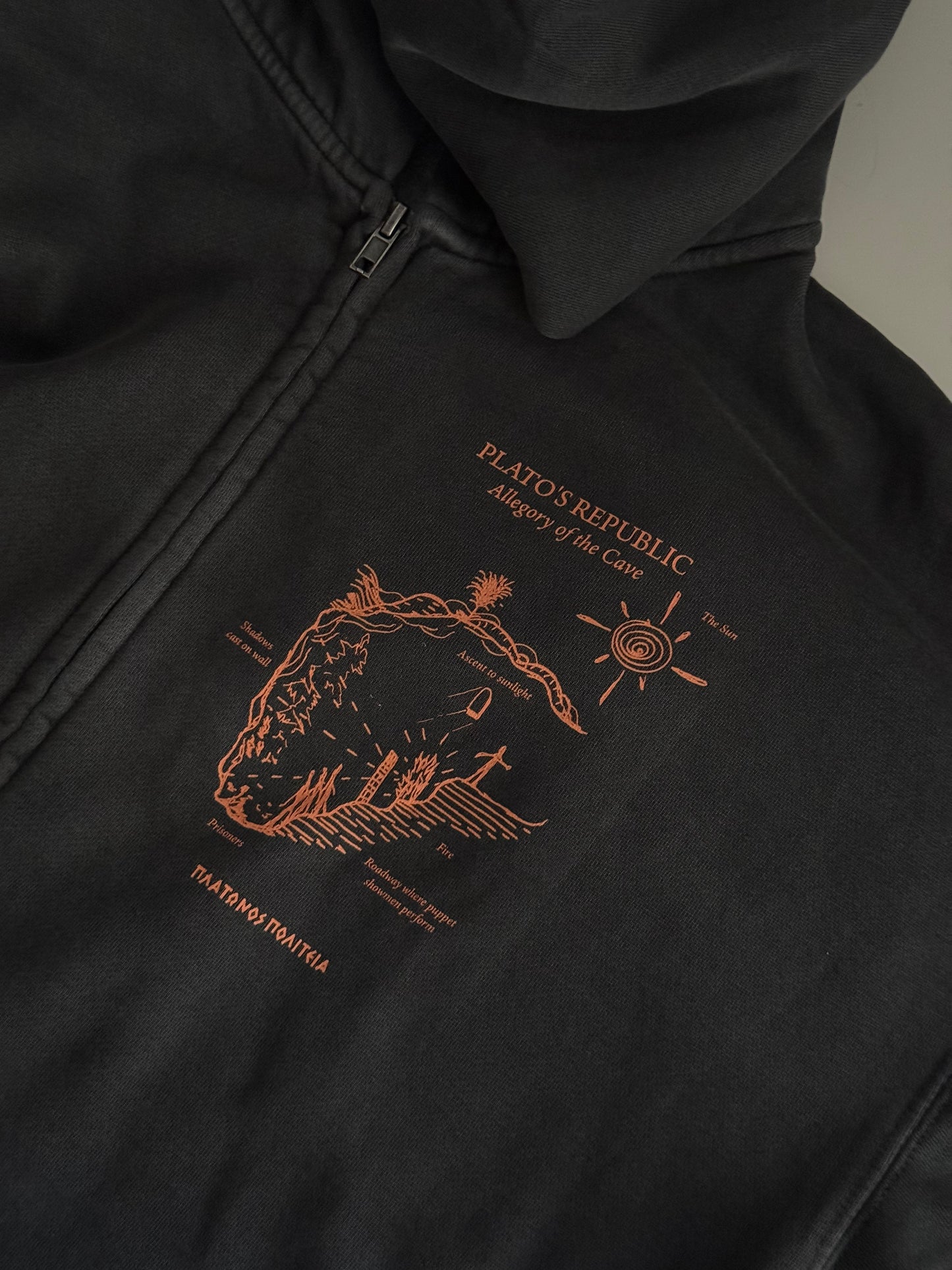
In the Allegory of the Cave, Plato begins by having Socrates ask Glaucon to imagine a cave where people have been imprisoned from childhood. These prisoners are chained so that their legs and necks are fixed, forcing them to gaze at the wall in front of them and not look around at the cave, each other, or themselves. Behind the prisoners is a fire, and between the fire and the prisoners is a raised walkway with a low wall, behind which people walk carrying objects or puppets "of men and other living things". The people walk behind the wall so their bodies do not cast shadows for the prisoners to see, but the objects they carry do ("just as puppet showmen have screens in front of them at which they work their puppets". The prisoners cannot see any of what is happening behind them, they are only able to see the shadows cast upon the cave wall in front of them. The sounds of the people talking echo off the walls, and the prisoners believe these sounds come from the shadows.

Socrates suggests that the shadows are reality for the prisoners because they have never seen anything else; they do not realize that what they see are shadows of objects in front of a fire, much less that these objects are inspired by real things outside the cave which they do not see.

The fire, or human made light, and the puppets, used to make shadows, are done by the artists. This can be compared to how illusions are made with light and sound today, with electronics, videos, movies, and 3D visuals. Plato, however, indicates that the fire is also the political doctrine that is taught in a nation state. The artists use light and shadows to teach the dominant doctrines of a time and place.
Also, few humans will ever escape the cave. This is not some easy task, and only a true philosopher, with decades of preparation, would be able to leave the cave, up the steep incline. Most humans will live at the bottom of the cave, and a small few will be the major artists that project the shadows with the use of human made light.

Plato then supposes that one prisoner is freed. This prisoner would look around and see the fire. The light would hurt his eyes and make it difficult for him to see the objects casting the shadows. If he were told that what he is seeing is real instead of the other version of reality he sees on the wall, he would not believe it. In his pain, Plato continues, the freed prisoner would turn away and run back to what he is accustomed to.
Plato continues: "Suppose... that someone should drag him... by force, up the rough ascent, the steep way up, and never stop until he could drag him out into the light of the sun." The prisoner would be angry and in pain, and this would only worsen when the radiant light of the sun overwhelms his eyes and blinds him.
 "Slowly, his eyes adjust to the light of the sun. First he can only see shadows. Gradually he can see the reflections of people and things in the reflection of the water and then later see the people and things themselves. Eventually, he is able to look at the stars and moon at night until finally he can look upon the sun itself.” Only after he can look straight at the sun "is he able to reason about it" and what it is. In other words, he would encounter another "realm", a place incomprehensible because, theoretically, it is the source of a higher reality than the one we have always known; it is the realm of pure Form, pure fact.